Computational models
Encoding models that connect sensory input, brain responses and behavior.
Our encoding models explain a brain response from the sensory input or from activity elsewhere in the brain, using parameters with a biological meaning. We then ask how those parameters vary across brain regions, how they change with attention and neurochemistry, and how they relate to behavior.
Approach
An fMRI voxel samples hundreds of thousands of neurons. On a retinotopic map, neurons with similar receptive fields lie close together, so each voxel has a preference: its population receptive field (pRF), the region of visual space it responds to. We fit pRF models to responses to mapping stimuli and extend them with computations such as divisive normalization.
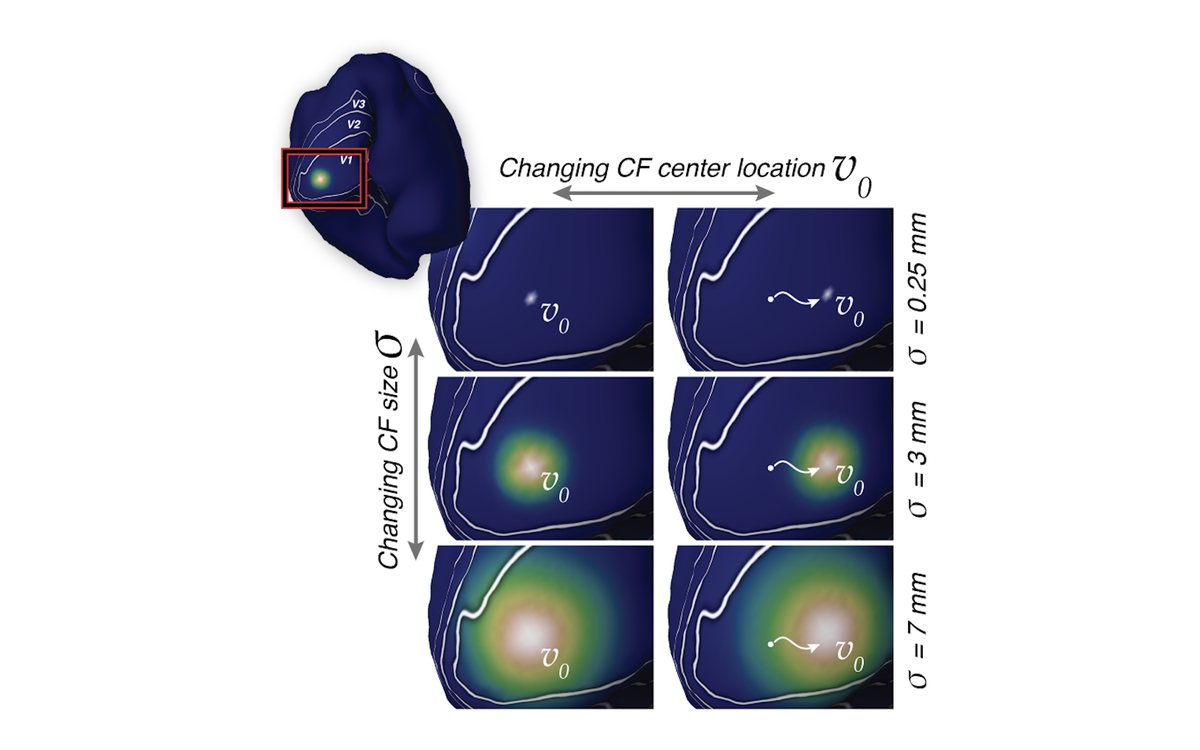
Connective field models apply the same idea from brain to brain. They explain a region’s responses from a Gaussian patch of activity on a topographic source map such as primary visual cortex (V1). Depending on the source map, the patch’s center stands for a location in visual space or a position on the body, and its size, in millimeters of cortex, measures the spatial scale of integration. They need only brain activity, so they can be fit to data from any experiment, including movie watching and rest (Knapen, 2021). For behavior and the pupil, we use models of learning and decision making to estimate latent processes trial by trial. Our model-fitting software is listed under software and data.
What we have found
Normalization explains diverse pRF responses. A pRF model based on divisive normalization captured seemingly disparate response signatures in human visual cortex with a single computation, and outperformed existing pRF models; its parameters varied systematically across the visual hierarchy (Aqil et al., 2021). Comparing these parameters from 7T fMRI with receptor density maps from positron emission tomography provided evidence that serotonin and GABA receptor densities are a biological substrate for modulations of normalization in the human visual system (Aqil et al., 2024).
Contextual computation under psilocybin. In humans, psilocybin altered contextual perception in the Ebbinghaus illusion and contextual modulation of visual cortical responses, and a computational model captured and linked both changes (Aqil et al., 2025).
Attention changes how visual cortex samples space. Spatial and feature-based attention interacted in how human visual cortex resampled space; an attentional gain field of varying precision explains this parsimoniously (van Es et al., 2018). Focused attention attracted pRFs toward the attended location more strongly than distributed attention did (Sheikh Abdirashid et al., 2025).
The pupil tracks learning variables. In a reinforcement learning task, the human pupil dilated before a choice with trial-by-trial value beliefs. After feedback, early dilation scaled with value uncertainty and later constriction with signed reward prediction errors (Van Slooten et al., 2018).
Open questions
Can a small set of canonical computations, with parameters set by local neurochemistry, account for responses beyond visual cortex? How should encoding models handle the eye movements and complex input of natural vision? To make these models easier to apply and extend, the Popylar project develops prfmodel, a community Python package for pRF and connective field modeling. Version 0.2.0 was released for our workshop in Coimbra in November 2026.
Papers
16 papers on this theme, selected papers first. Filter the full list.
-
Vicarious body maps bridge vision and touch in the human brain
-
Psilocybin alters visual contextual computations
-
Computational model links normalization to chemoarchitecture in the human visual system
-
Divisive normalization unifies disparate response signatures throughout the human visual hierarchy
-
Topographic connectivity reveals task-dependent retinotopic processing throughout the human brain
-
Spatial sampling in human visual cortex is modulated by both spatial and feature-based attention
-
Non-invasive mapping of the temporal processing hierarchy in the human visual cortex
-
The precision of attention controls attraction of population receptive fields
-
Contextual responses drive a unique laminar signature in human V1
-
Learning in Visual Regions as Support for the Bias in Future Value-Driven Choice
Show all 16 papersShow fewer papers
-
Dopaminergic medication reduces striatal sensitivity to negative outcomes in Parkinson's disease
-
Cross-Task Contributions of Frontobasal Ganglia Circuitry in Response Inhibition and Conflict-Induced Slowing
-
Implicit and explicit learning in reactive and voluntary saccade adaptation
-
How pupil responses track value-based decision-making during and after reinforcement learning
-
How Visual Cortical Organization Is Altered by Ophthalmologic and Neurologic Disorders
-
Cognitive and Ocular Factors Jointly Determine Pupil Responses under Equiluminance
People

Ningkai Wang
PhD student (co-supervised with Jan Theeuwes)
Former lab members who worked on this theme: Nick Hedger, Marco Aqil, Sumiya Sheikh Abdirashid, Ron van de Klundert.
Software & data
prfmodel (Popylar)
BetaPython package for fitting population receptive field models (including compressive spatial summation, difference-of-Gaussians and divisive normalization variants) and related models such as connective field and contrast sensitivity models, on GPU-accelerated backends (TensorFlow, PyTorch or JAX, through Keras 3). Developed by the Popylar team with the Netherlands eScience Center.
pip install "prfmodel[tensorflow]"prfpy
AvailablePython package to simulate and fit population receptive field (pRF) models to time series data, including the divisive normalization pRF model. prfmodel, developed in the Popylar project, builds on it.
nideconv
MaintainedPython package to estimate the shape of responses in fMRI, pupil and other time series by deconvolution, including hierarchical Bayesian estimation.
pRFtime
AvailablePython toolbox for spatiotemporal forward modeling of brain signals. It combines pRF maps from fMRI with MEG to estimate when each visual field map contributes to the measured response.
Vicarious somatotopy analysis code
AvailableAnalysis code for the vicarious body maps study, which fits connective field models of somatosensory and visual topography to 7T Human Connectome Project data.