Jurjen Heij was a neuroscience PhD student at the Spinoza Centre working on line-scanning fMRI. He developed the methods to plan the line so that it targets a small, preselected patch of cortex, and used pRF modeling and time-course estimation to answer his research questions.
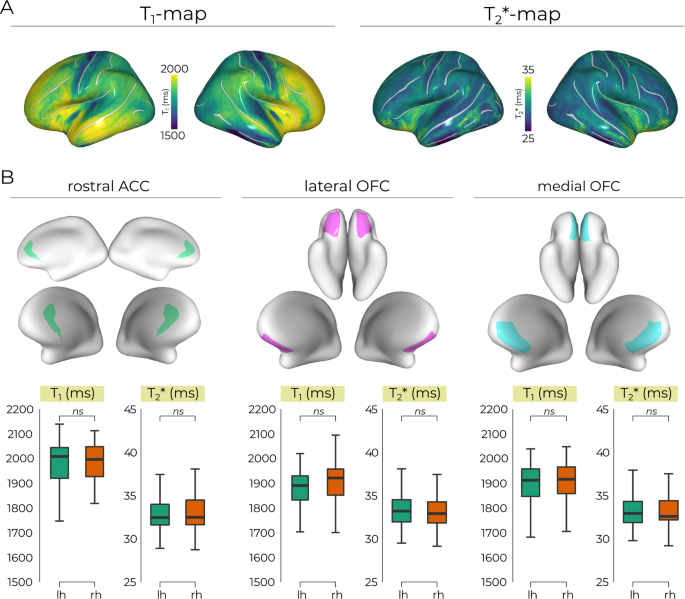
His framework selects a target location from anatomical and functional data and places the line there in a later session (Heij et al., 2023). With it he showed that stimuli in the center and in the surround of a population receptive field evoke distinct response profiles across cortical depth in V1 (Heij et al., 2025). He also used quantitative 7T MRI to study intracortical myelination in major depressive disorder (Heij et al., 2024). His analysis tools are in the linescanning package.
Publications from the lab
-
Contextual responses drive a unique laminar signature in human V1
- Computational models
-
Does the Cortical-Depth Dependence of the Hemodynamic Response Function Differ Between Age Groups?
-
Quantitative MRI at 7-Tesla reveals novel frontocortical myeloarchitecture anomalies in major depressive disorder
- Precision neuroimaging
-
A selection and targeting framework of cortical locations for line-scanning fMRI
- Precision neuroimaging
-
Towards functional spin-echo BOLD line-scanning in humans at 7T
- Precision neuroimaging
-
Robust high spatio-temporal line-scanning fMRI in humans at 7T using multi-echo readouts, denoising and prospective motion correction
- Precision neuroimaging