Tomas Knapen leads the lab. He has been a principal investigator and group leader in Cognitive Psychology at the Vrije Universiteit Amsterdam (Faculty of Behavioural and Movement Sciences) since 2013, and a senior researcher at the Spinoza Centre for Neuroimaging (KNAW) since 2017. Since 2019 he has also been affiliated with the Netherlands Institute for Neuroscience (KNAW).
He studied theoretical biology at the University of Amsterdam (MSc, 2002) and received his PhD in experimental physics from Utrecht University in 2007, in the “Physics of Man” group of the Helmholtz Institute. He did postdoctoral work at Université Paris Descartes, Vanderbilt University and the University of Amsterdam before starting the lab.
His research asks how the brain’s topographic maps organize perception, action and social cognition. He came to neuroimaging from psychophysics, and the lab still puts weight on the behavioral side of every task. His training in a physics department shows in a preference for explicit models that explain the findings, and in the effort the lab spends on understanding the signals it measures as fully as possible.
His work has been funded by an NWO VIDI grant and by the Netherlands eScience Center, which supported the development of prfpy and, since 2025, supports the Popylar project (Open eScience Call 2024). Popylar develops prfmodel, a community package for population receptive field modeling. He has also received funding from the Tiny Blue Dot Foundation for a project on body-based meditation and psilocybin.
Selected publications
-
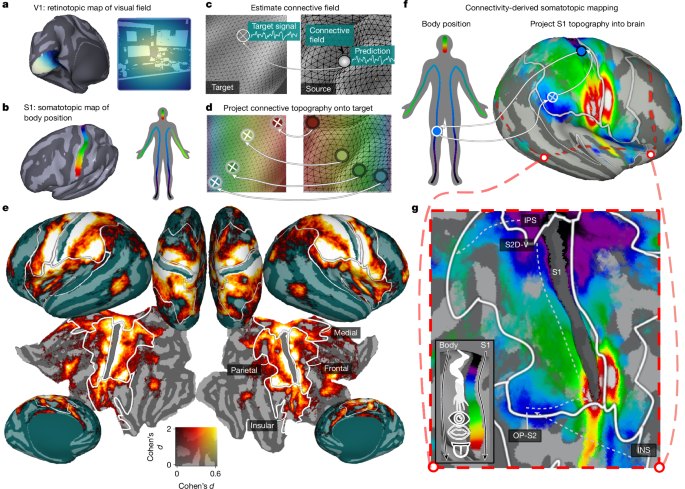
Vicarious body maps bridge vision and touch in the human brain
- Topographic maps
- Computational models
-
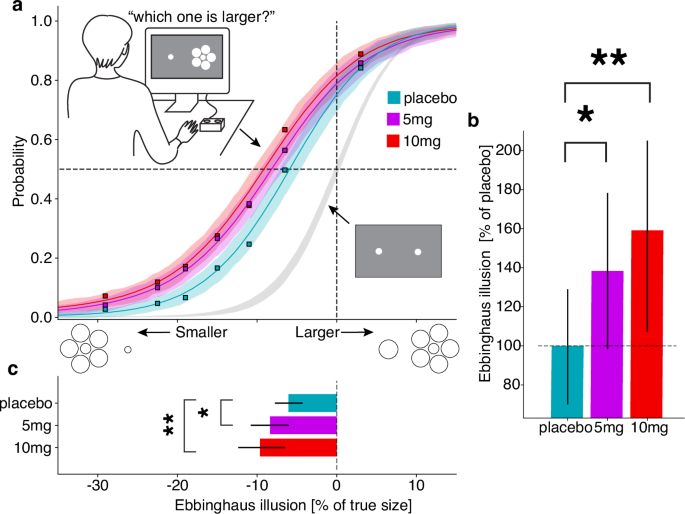
Psilocybin alters visual contextual computations
- Computational models
- Perception and awareness
-
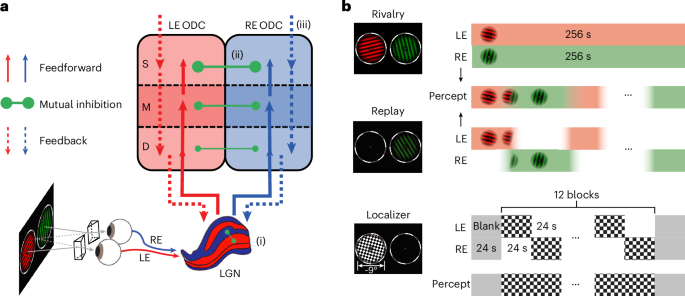
Mesoscale cortical mechanisms of perceptual conflict resolution in binocular rivalry
- Perception and awareness
-
Principles of intensive human neuroimaging
- Precision neuroimaging
-
Computational model links normalization to chemoarchitecture in the human visual system
- Computational models
-
Visuospatial coding as ubiquitous scaffolding for human cognition
- Topographic maps
-
Divisive normalization unifies disparate response signatures throughout the human visual hierarchy
- Computational models
-
Topographic connectivity reveals task-dependent retinotopic processing throughout the human brain
- Topographic maps
- Computational models
-
Ultra-high field fMRI reveals origins of feedforward and feedback activity within laminae of human ocular dominance columns
- Perception and awareness
-
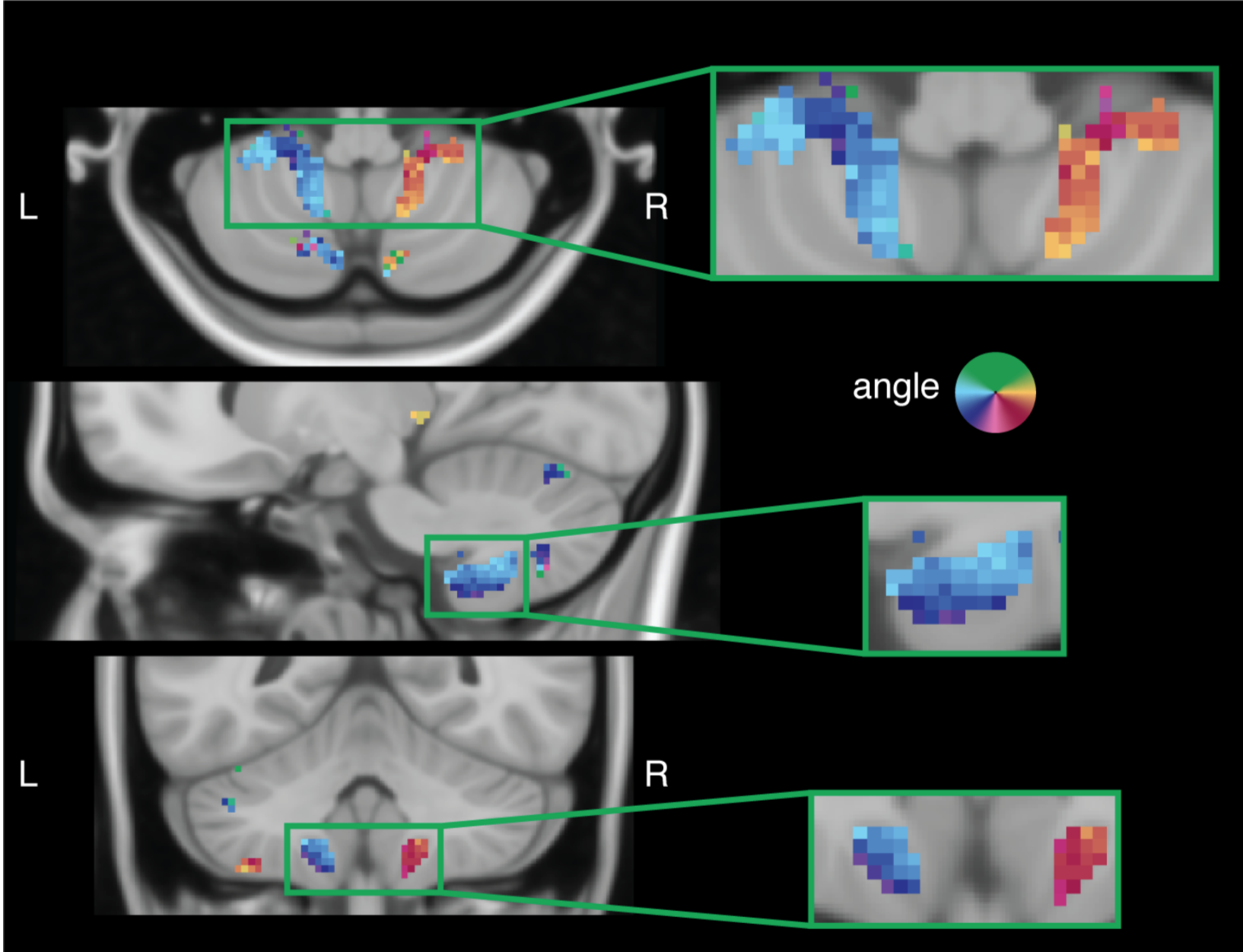
Topographic Maps of Visual Space in the Human Cerebellum
- Topographic maps
-
Spatial sampling in human visual cortex is modulated by both spatial and feature-based attention
- Computational models
- Perception and awareness
-
Negligible fronto-parietal BOLD activity accompanying unreportable switches in bistable perception
- Perception and awareness
-
Decision-related pupil dilation reflects upcoming choice and individual bias
- Perception and awareness